Selecting the right materials for infant care requires a balance between high absorbency, skin compatibility, and manufacturing scalability. For brands entering the baby textile market, the transition to professional production often centers on optimizing the fabric's tactile properties while maintaining strict safety standards.
The demand for hypoallergenic and breathable accessories has pushed manufacturers toward specialized knitting techniques. Unlike woven fabrics, knitted structures offer the elasticity and softness necessary for a baby's sensitive skin, making the choice of yarn and gauge critical for the final product's performance.
Whether you are developing a new product line or refining an existing one, understanding the nuances of oem 100% cotton knitted baby bibs is essential for achieving a competitive edge in the global home and baby textile industry.


Pure cotton remains the gold standard for infant accessories due to its natural hypoallergenic properties and superior moisture absorption. In the context of baby bibs, the "knitted" aspect is what differentiates the product from traditional woven cotton, providing a stretchable, soft-touch surface that conforms to the baby's neck without irritation.
The move toward 100% cotton is not merely a trend but a safety requirement for many international markets. By eliminating synthetic blends in the top layer, manufacturers reduce the risk of contact dermatitis and ensure that the product remains breathable during feeding and teething periods.
The technical performance of baby bibs depends heavily on the knit gauge and the yarn count. A tighter knit generally provides better durability and a smoother finish, whereas a looser knit can enhance absorbency. For OEM production, adjusting these variables allows brands to target different market segments, from luxury high-density knits to economical daily-use options.
Furthermore, the integration of specific knitting patterns, such as interlock or jersey, affects how the bib handles repeated washing. Interlock knits are typically thicker and more stable, preventing the edges from curling, which is a common quality issue in lower-grade baby garments.
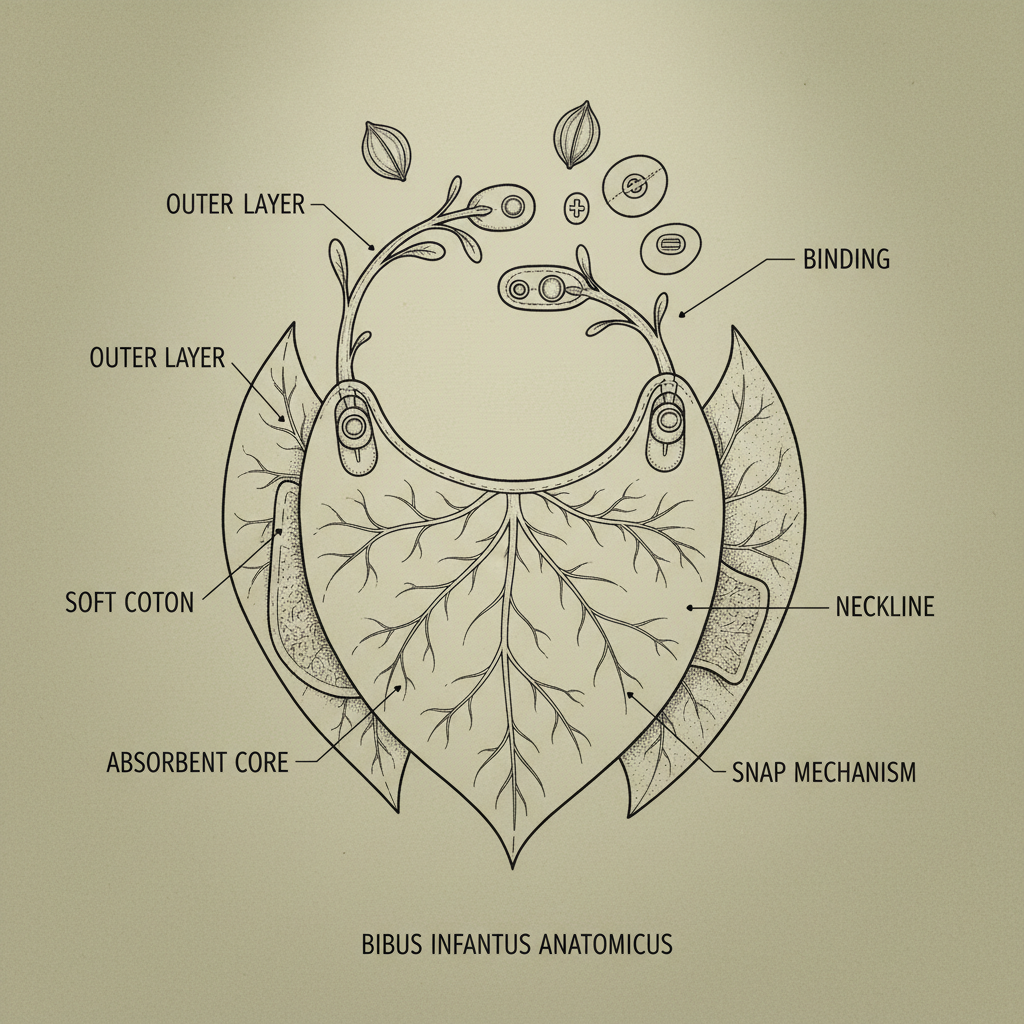
Precision in the stitching of the binding and the attachment of fasteners—such as snaps or Velcro—is where technical expertise is most visible. High-quality manufacturing ensures that these attachments are securely reinforced to prevent choking hazards, adhering to strict infant product safety regulations.
Quality assurance for infant textiles extends beyond the visual inspection of the garment. It involves rigorous testing for chemical residues, including formaldehyde and azo dyes, which are strictly regulated in baby products. The dyeing process must utilize non-toxic, eco-friendly pigments to ensure the bibs are safe for babies who frequently chew on their clothing.
The primary metric for infant textile safety is the absence of skin-irritating chemicals and the maintenance of fabric breathability, ensuring that the accessory does not trap heat or moisture against the skin.
Implementing a comprehensive quality control system—from the sourcing of raw cotton to the final packaging—is the only way to maintain consistency in large-scale OEM orders. This includes checking for "pilling" resistance and color fastness, ensuring that the bibs maintain their aesthetic and functional integrity after dozens of laundry cycles.
While 100% cotton is ideal for skin contact, some manufacturers experiment with blends to achieve specific functional goals, such as faster drying times or increased elasticity. However, these trade-offs often come at the expense of pure hypoallergenic properties and absorbency.
To illustrate the differences, we can look at a relative performance index comparing pure knitted cotton against common industry alternatives. This model evaluates the materials based on absorbency, softness, and skin safety.
In a typical industrial setting, a brand seeking OEM services for baby bibs must provide detailed specifications regarding GSM (grams per square meter) and specific knit patterns. For instance, a brand focusing on "premium" baby care might request a higher GSM for better absorbency, while a "travel-friendly" line might prioritize a lighter, more compact knit.
The manufacturer's role is to translate these brand requirements into technical machine settings. This involves selecting the correct needles, yarn tension, and dyeing cycles to ensure the final product matches the prototype. Companies like SUNTEX leverage years of experience in baby and home textiles to ensure that these customized requirements are met with punctual delivery and consistent quality.
The baby textile industry is shifting toward circular economy principles. This means moving beyond just "100% cotton" toward organic cotton (GOTS certified) and recycled fibers that do not compromise the softness required for infants. The goal is to reduce the water footprint and chemical usage during the cultivation and processing of cotton.
Another emerging trend is the integration of "smart" textiles, such as moisture-sensing fabrics or antimicrobial finishes that are naturally derived. While still in the early stages for basic items like bibs, these innovations are driven by a growing consumer demand for proactive health monitoring and enhanced hygiene.
Furthermore, the transition toward biodegradable packaging and plastic-free shipping is becoming a standard requirement for OEM partnerships. Brands are no longer just evaluating the product, but the entire supply chain's environmental impact, forcing manufacturers to adopt greener production methods.
When evaluating a manufacturer for oem 100% cotton knitted baby bibs, buyers should look beyond the price per unit. The true value lies in the manufacturer's ability to maintain consistency across large batches and their adherence to international safety standards.
A critical part of the selection process is comparing the trade-offs between different knitting styles and material certifications. A manufacturer that can provide full traceability of the cotton source offers a significant advantage in markets with strict transparency laws.
The following table provides a decision framework for buyers to assess different production options based on typical market needs.
| Market Segment | Recommended Knit | Priority Factor | Suitability Index |
|---|---|---|---|
| Luxury / Organic | High-Gauge Interlock | GOTS Certification | Very High |
| Mass Market | Standard Jersey | Cost-Efficiency | High |
| Medical / Sensitive | Fine-Knit Hypoallergenic | Chemical Purity | Critical |
| Budget / Daily | Low-GSM Single Knit | Production Speed | Medium |
| Eco-Friendly | Recycled Cotton Knit | Carbon Footprint | High |
| Premium Comfort | Terry-Knit Cotton | Absorbency Rate | Very High |
Knitted structures offer natural elasticity and a softer surface texture compared to woven fabrics. This is crucial for infants because it allows the bib to fit comfortably around the neck without creating pressure points or causing skin abrasion. Additionally, knitted fabrics generally possess better absorbency and breathability, which are essential for managing drool and spills effectively while keeping the baby's skin dry.
A professional manufacturer should possess a comprehensive quality control system that specifically covers infant safety. Key indicators include certifications for non-toxic dyes, the ability to provide fabric test reports for chemical residues, and a proven track record of punctual delivery. You should also evaluate their technical capability to handle different GSM requirements and their experience with reinforced stitching to prevent safety hazards.
GSM (grams per square meter) measures the fabric's weight and density. A higher GSM typically indicates a thicker, more absorbent fabric, which is ideal for heavy teething periods but may be slower to dry. A lower GSM results in a lighter, more breathable bib that is easier to pack for travel. The optimal choice depends on the intended use case and the target climate of the end consumer.
Yes, many OEM manufacturers can laminate a thin waterproof layer, such as TPU, to the back of the 100% cotton knitted top fabric. This creates a hybrid product that combines the softness and skin-friendliness of cotton with the functional protection of a waterproof barrier, preventing liquids from seeping through to the baby's clothing. This is a common request for high-end feeding bibs.
Common failures include edge curling in jersey knits, pilling after multiple washes, and the loosening of snap fasteners. High-quality OEM production avoids these issues by using interlock knits for better stability, employing long-staple cotton to reduce pilling, and using industrial-grade reinforcement stitching around all attachment points to ensure durability and safety.
From a purely functional perspective, both provide high absorbency and softness. However, organic cotton is grown without synthetic pesticides and fertilizers, and processed without harsh chemicals. For babies with extremely sensitive skin or for brands targeting the eco-conscious market, organic cotton provides an added layer of safety and sustainability that standard cotton may not offer.
The production of high-quality baby textiles is a precise science that balances material purity with industrial efficiency. By prioritizing 100% cotton knitted structures, brands can ensure a product that is not only comfortable but fundamentally safe for the most vulnerable users.
As the industry moves toward greater sustainability and stricter safety regulations, the partnership between a brand and its OEM manufacturer becomes the critical factor in success. Choosing a partner with deep technical expertise in knitted fabrics ensures that every bib produced meets the high expectations of modern parents worldwide.